Showing posts with label figurine. Show all posts

Saturday, September 21, 2013

dog and cat figurine | American Dog Blog


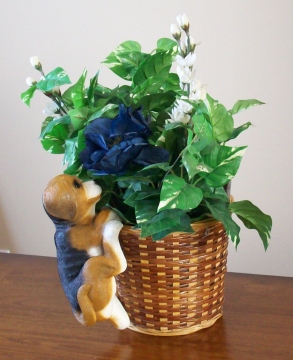
Animal Figurine Store.com has recently added new puppy figurines. Check out the puppy figurine pot hangers. What are pot hangers? Pot hangers are animal figurines designed to hang off the edge of your potted plants. Notice the above photo of an adorable puppy figurine which looks like he is climbing into a potted plant.


These puppy figurines come in a few selective breeds such as the Rottweiler puppy figurine, Spaniel puppy figurine, Westie puppy figurine, Yorkie puppy figurine, Shar-Pei puppy figurine, and more. Most of these puppy figurines are about 3″ high, 2″ wide, and 2″ long. But there is also a larger puppy figurine pot hanger of the Beagle. It is about 8″ high, 4″ wide, and 4″ long.


Oh, and there is also a few cat figurine pot hangers. They are slightly smaller than the smaller puppy figurine pot hangers, but they are just as adorable.  Visit the dog and cat figurine page from Animal Figurine Store.com and select the appropriate group depending on your favorite dog breed or cat.

Saturday, September 14, 2013

dog figurine | American Dog Blog


Dog figurines from Animal Figurine Store

Dog Figurines from the Animal Figurine Store


The holidays are here once again.  It is time to visit family, to be thankful for all the goodness in your life, to remember the good spirit of humanity, and to let your friends and family know how much you care.  While you don’t always have to give a gift in order for someone know you care, it makes you feel good.  I love it when I get a card from a friend.  Gifts are nice too, but not necessary.  But when I see that look on their face as they hand me the gift, I know that it’s a gift which they put special thought into just for me.  I can’t help but to appreciate their friendship all the more.


All my friends know that I am a big lover.  So most of the time, I am given gifts which have to do with dogs – a book about dogs, a dog toy, something I can use for my dogs, or just a gift with a dog theme.  If you have a dear friend who loves dogs as much as I do, consider getting them such a gift.  A dog figurine of their beloved pet can be something special and a great keepsake.  A dog car seat belt for their dog is another idea.  A dog lover will genuinely appreciate that you not only thought about them, but that you also thought about the special four-legged friend in their life.


As a gift to you, we are giving you a special discount on Pet Auto Safety.com and Animal Figurine Store.com.  To get 15% off, enter discount code, holidaypet.  That is spelled in all lower-case and all one word.  Feel free to use it anytime.  But be sure to place an order early.  We don’t offer rush shipping so the earlier you place your order, the better.


Great Dane Dog Breed

Great Dane Dog Breed


Despite the name, the Great Dane dog breed is not a Danish dog. He is a very old German dog breed. In ancient times, the Great Dane was used as a wardog and as well as for hunting boar. In fact, the Great Dane has been called a German Boarhound. The Germans, however, call him Deutsche Dogge.


The Great Dane is a big dog yet proportionately very graceful and elegant in appearance. Standing 28” to 35” tall and weighing 110-180 pounds, the Great Dane is truly a large dog breed but mostly very gentle. While the Great Dane dog breed was bred for courage on the hunt, he is only a good guard dog in the intimidation of his size. Otherwise, he is generally friendly to strangers. The Great Dane can be very affectionate and easygoing with people but may not get along well with other pets.


Although the Great Dane is not as eager to please as a Labrador Retriever, he is moderately easy to train. He can be a bit sensitive in training so use mostly positive reinforcement methods for maximum response.


You would think that such a large gallant dog would require a lot of exercise. But the Great Dane dog breed only needs moderate daily exercise. He is not overly energetic or playful. His easy nature makes him a great house dog but he needs a big bed and enough room to stretch out his long legs. Grooming for a Great Dane is even easier. Occasional brushing during shedding season or after baths may be all that is required. The only major upkeep concern for the Great Dane is his tendency to drool.


Health concerns for the Great Dane dog breed are relatively few, but require serious consideration if you want to buy one. As with most large breed dogs, the Great Dane has the risk of developing hip dysplasia. Elbow dysplasia is also a concern. Both of these can be tested and a good dog breeder will be willing to provide proof of such testing. Since a dog doesn’t develop hip or elbow dysplasia until after a year or more, do not accept any 1 year guarantees that an unscrupulous breeder may offer.


Other health concerns common with the Great Dane dog breed include gastric torsion, cardiomyopathy, and bone cancer. Gastric torsion is where the stomach twists and traps contents – a very dangerous situation which can cause death. Gastric torsion is not necessarily genetically inherited health risk like hip dysplasia. It is a health risk associated with large dogs in general. Cardiomyopathy is where the chambers of the heart enlarge and cause congestive heart failure. This health issue can also be inherited.


Besides his great size, features of the Great Dane dog breed are quite recognizable. If you have ever heard of the comic character (now movie character) Marmaduke, then you are already familiar with how the Great Dane looks. He has a long rectangular head, square jaw, and a thick heavy muzzle. Overall, his body is equally proportioned – his chest is neither too deep nor too narrow, his legs are long but not so long as in comparison to his body. The ears of a Great Dane are medium sized and droop. However, when his ears are cropped they stand erect.


The Great Dane dog breed comes in a variety of interesting and unique colors. The Great Dane which is white with irregular patches of black is called a Harlequin Dane. The term ‘harlequin’ for a black and white dog is unique to the Great Dane. The Great Dane dog breed can also be brindle in color. Brindle is a light color with black cross stripes, like a tiger but the stripes are much smaller. A fawn colored Dane is a Great Dane which is golden-yellow or tan color and has a black mask on his face. A blue colored Dane is a Great Dane which is a solid gray-blue. And finally, the Great Dane dog breed can also be a solid black in color.


The Great Dane is a great dog. Except for the dog food bill, his easygoing nature makes him generally easy to care for. He is perfectly content being an indoor dog and does not require a big yard – or any yard as long as he gets regular walks. If you want to purchase a Great Dane, be sure to research breeders thoroughly in order to avoid any unscrupulous dog breeders who don’t breed quality dogs and don’t check for inherited health issues like hip dysplasia, cardiomyopathy, and bone cancer. You can also check online or at your local animal shelter for Great Dane rescue groups. A Great Dane rescue group rescues and adopts out Great Dane dog breeds who might have been displaced, neglected, or given up by their owners for various reasons.


For a great Great Dane dog figurine, visit AnimalFigurineStore.com.


New to the Animal Figurine Store.com are your favorite dog breed figurines in a devil costume. We love our dogs but sometimes they have quirky little annoying traits, or sometimes they do some naughty things. That is where the Devil Dog Breed Figurines come in.

Take my dog, Maya, for example. She is basically a good dog. But there was this one time when we went to the dog park and the first thing she did was find a big muddy puddle and jump in it. Its what dogs do so I couldn’t be mad at her, but I couldn’t help thinking, “You little devil!” At that moment, the Labrador Retriever Devil Dog Breed Figurine was a perfect representation of her.


There was another time when we went to a park which had a big fountain. The water of the fountain was dyed pink for Breast Cancer Awareness week. Maya, being a Labrador Retriever and all, saw the water and bolted so quickly that I lost hold of her leash. Next thing you know, she is playing in pink water. Since Maya is a Yellow Labrador Retriever, she turned pink for a week. It was really funny but I couldn’t help thinking, “You cute little devil!” Once again, the Labrador Retriever Devil Dog Breed Figurine was the perfect representation of her. I keep a Yellow Labrador Retriever Devil Dog Breed Figurine on my desk at work.


My parents have a Lhasa Apso named Killer. Killer is basically a good dog with some annoying habits. He likes to take food out of his bowl and take it into another room to eat. Every once in a while, my parents step on a piece of food which had been dropped in the hallway. I’m sure that when they say, “Ouch!”, they are actually thinking, “You little devil!” They now have a Lhasa Apso Devil Dog Breed Figurine on their curio shelf at home.


Although sometimes we call our dogs “brats” or “little devils” we say it out of love. And sometimes when we think back on bad things they have done, we can’t help but to laugh. Get a Devil Dog Breed Figurine to help remind you of those times. Visit the Animal Figurine Store.com and enter “devil” in the search field to pull up all our Devil Dog Breed Figurine gifts. See if we have a Devil Dog Breed Figurine for your dog’s breed.


Friday, September 13, 2013

australian shepherd figurine | American Dog Blog


Australian Shepherd Dob Breed

Australian Shepherd Dog Breed


The Australian Shepherd dog breed as we know him today is considered a US dog breed.  His ancestors came from Europe, relocated to Australia, then found their way to California.  So if the Australian Shepherd dog breed came from Europe, why is he considered to have origins in the United States?  And why is he called an Australian Shepherd?  He is probably considered a US dog breed because his breed was perfected in the US.  And he is probably considered an Australian Shepherd because that is what the people in California called his predecessors.  The dogs which originally came to California from Europe and Australia were mixed breeds, possibly Kelpie and/or Scottish Border Collie mix.  And they were probably also mixed with yet other breeds which later gave us the standard breed which we call Australian Shepherd.


As a result of the mix of various herding breeds across the world, the Australian Shepherd dog breed is a hardy breed with exceptional herding skills.  He can withstand the hot temperatures of Australia as easily as the colder weather of Europe.  His herding skills are diverse – sheep, cattle, you name it, he can herd it.  The Australian Shepherd dog breed is also good at hunting and tracking.  He is very intelligent and easy to train so he has also been used as a messenger dog in World War II, to perform tricks at rodeos and on film, and for search and rescue.


The Australian Shepherd dog breed never tires.  The high energy of the Australian Shepherd dog breed makes him great at herding and other skills, but sometimes not so great at being a house dog.  If he does not get enough exercise and mental stimulation, he can develop bad behaviors such as getting into things, chewing, jumping the fence, and running off.  If you plan on getting an Australian Shepherd dog breed, be prepared to provide him with a very active lifestyle.  He is highly energetic and playful so play with him plenty and give him some stimulating dog toys such as a Buster Food Cube.  Also take him on some strenuous walks or runs every day.


While the Australian Shepherd dog breed can be independent in nature, he is affectionate and eager to please.  He can get along well with other pets but he may try to herd smaller pets.  He is both gentle and patient with children, but he may also be inclined to herd small children.  He is bold, alert, and wary of strangers so the Australian Shepherd is a natural watchdog.


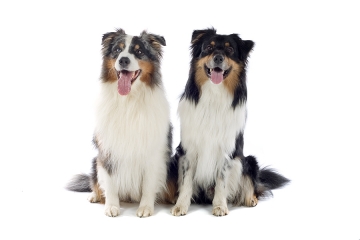
The Australian Shepherd dog breed can be interesting in color.  He can be black or red with white, and sometimes have tan markings.  Or he can be blue merle (pictured above) or red merle, also with white and possible tan markings.  His eyes can be brown, amber, or blue, or flecked with any combination of those colors.  He has short hair around his face, ears, and front feet but the rest of his coat is medium in length, either straight or wavy.  His top coat is water resistant and his undercoat is thick.  This double coat requires brushing at least twice weekly.


The Australian Shepherd dog breed stands about 18-23 inches high and can weigh 40-65 pounds.  He has triangular ears set high on the head and folded forward or to the side.  And the tail of an Australian Shepherd dog breed is either docked or naturally bobbed.  He has broad feet which are oval in shape.  His muzzle and head are equal and moderate in length.  And he has a straight and level back.


If you are considering purchasing an Australian Shepherd dog breed, be sure to research the breeder thoroughly.  The Australian Shepherd dog breed is prone to a number of hereditary diseases which are more common in dogs bred by irresponsible breeders.  Common hereditary diseases of the Australian Shepherd dog breed include cataracts, collie eye anomaly, nasal solar dermatitis, Pelger-Huet syndrome, hip dysplasia, and ivermectin sensitivity.  Many of these diseases can be and should be tested for by the breeder.


The Australian Shepherd dog breed is perfect for a family with an active lifestyle.  He can be a great playmate for your older children, would love to go running or follow you on your bicycle, loves to play fetch, enjoys learning new tricks, and just loves to be loved.  To find the perfect dog for your family, research for a good breeder, visit an animal shelter, or contact an Australian Sheepdog rescue group.


Australian Shepherd Dog Breed Figurine
Australian Shepherd Dog Breed Figurine